Hyperpersonalization of Creative: The Self-Licking Ice Cream Cone
Use AI to generate hundreds of ad creative variations from a single winning template. Personalize landing pages by visitor segment. Build UGC-style content with AI avatars. Alex Hormozi calls it the 'self-licking ice cream cone' -- customers create the creative that gets more customers.
AI Ad Creative Variations -- upload 1 winning ad, get 50 variations. Pay per generation.
The Pattern
Every performance marketer has the same problem: ad fatigue. A winning creative works brilliantly for 3-7 days, then engagement drops as the audience becomes saturated. The solution has always been to produce more variations — different backgrounds, different copy angles, different visual styles — but the production cost of creating those variations manually has been the bottleneck. A single ad creative variation used to cost $50-200 in designer time. When you need 50 variations per week across multiple platforms, the math breaks.
AI changes this equation completely. Generating creative variations from a template is now nearly free in terms of marginal cost. The constraint shifts from “how many can we afford to produce?” to “how intelligently can we test and iterate?” Alex Hormozi describes this as the “self-licking ice cream cone” — a system where the output (creative that converts) feeds back into the input (data about what works) to generate even better output. The loop is: create variations, test them, identify winners, generate new variations based on the winners, repeat.
This is not a marginal improvement in marketing efficiency. It is a structural advantage. Companies that master hyperpersonalized creative will outperform competitors by orders of magnitude on customer acquisition cost, because they are running thousands of simultaneous experiments while competitors are running dozens.
Key Quotes
“Hyperpersonalization is going to be… we have to build the self-licking ice cream cone. How do I get the customers to make creative that gets us more customers then make more creative.” — Alex Hormozi, 22:44
The “self-licking ice cream cone” metaphor is deliberately absurd, but the concept is precise. The ideal system is one where customer behavior data continuously improves the creative that attracts more customers, creating a compounding advantage. Every dollar spent on customer acquisition also improves future acquisition efficiency.
“Use the same hook that worked before — different background, different shirt, same hook. A/B test everything.” — Alex Hormozi
This is the operational translation of the concept. You do not need to reinvent the creative strategy. You take what already works and multiply it across visual variations. The hook (the first 3 seconds of a video, the headline of an ad) is the most important element. Keep the proven hook, change everything else, and test which combination performs best.
“The future of GTM is hyper-customization at scale. Every prospect gets a different landing page, different email, different ad — all generated dynamically based on their company, role, and behavior.” — SaaStr panel on AI-driven go-to-market, 8:02
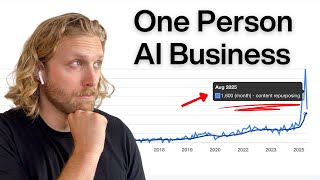
“One person AI business you can do from home — build an ad creative variation engine. Performance marketers will pay $500-1000/month because it directly increases their ROAS.” — Cody Schneider, 0:45
Lovable hit $200M ARR in one year by applying hyperpersonalization at the product level — every user gets a uniquely generated app, not a template. The product itself is the creative variation engine. — Lenny’s Podcast, on Lovable’s growth playbook
AI Jason’s 2025 GenAI retrospective highlights that the companies that survived the consolidation wave were those that turned AI into a personalization layer, not a feature checkbox.
Wes Roth argues the “AI bubble” that popped was the bubble of generic AI wrappers — the survivors are companies where AI is deeply integrated into the value delivery, not bolted on.
Prediction Check
Lovable’s $200M ARR validates the thesis: Lovable (formerly Lovable.dev) reached $200M ARR in a single year by doing exactly what the hyperpersonalization thesis predicts: making every output unique to the user. Instead of offering templates, Lovable generates entire applications from natural language descriptions. Every user gets a different product. This is hyperpersonalization applied not to marketing creative but to the product itself — and the growth numbers prove the model works. The “self-licking ice cream cone” is real: users create apps, share them, attract more users who create more apps.
GenAI market consolidation (2025-2026): AI Jason’s retrospective on what actually happened in GenAI in 2025 confirms a pattern: the generic AI wrapper companies died. The survivors fell into two camps — infrastructure plays (the “picks and shovels”) and companies that used AI to deliver hyperpersonalized outputs at scale. The middle ground of “AI-powered [generic SaaS feature]” collapsed because the LLM providers themselves absorbed that functionality. The lesson for builders: hyperpersonalization is a defensible moat because it compounds with data. Generic AI features are not defensible because they are commoditized by the model providers.
The creative variation market has matured: What Cody Schneider described as a one-person AI business opportunity in 2025 has become a crowded market in 2026. Dozens of tools now generate ad creative variations. The differentiation has moved upstream: the winners are not the tools that generate the most variations, but the ones that close the loop between creative generation and performance data. The self-licking ice cream cone requires both halves — generation and measurement — working together. Tools that only do generation are commoditized; tools that also ingest performance data and auto-optimize are the ones capturing value.
Wes Roth’s “bubble pop” reframing: The AI bubble that popped was not AI itself — it was the bubble of shallow AI integration. Companies that slapped “AI-powered” on existing products without fundamentally changing the value proposition have been washed out. What remains are companies where AI is the product (Lovable, Cursor, Midjourney) and companies where AI creates a compounding data advantage (hyperpersonalized creative, dynamic pricing, adaptive UX). This is the filter for evaluating any new AI startup idea: does the AI create a compounding advantage, or is it a feature?
Concrete Ideas
- AI ad creative generator — upload one successful ad creative (image or video), and the system generates 50 variations. For images: different backgrounds, color schemes, text positions, font styles, and visual treatments, all preserving the core message and hook. For video: different intros, background music, text overlays, pacing, and thumbnail options. Each variation is sized for the target platform (1:1 for Instagram, 9:16 for Reels/TikTok, 16:9 for YouTube).
- Dynamic landing page personalization — a single landing page that renders differently for each visitor based on their referral source, industry, company size, and geographic location. A SaaS product’s landing page shows healthcare case studies to visitors from hospital domains, fintech testimonials to visitors from banking IPs, and startup-focused copy to visitors from Product Hunt. The personalization is powered by reverse IP lookup, UTM parameters, and cookie data.
- UGC content system with AI avatars — user-generated content (UGC) style videos are the highest-converting ad format, but producing them requires hiring real people, scripting, filming, and editing. AI avatar technology can now generate realistic talking-head videos that look like genuine testimonials. The system takes a script and a persona description, and produces a UGC-style video ready to deploy as an ad.
- Personalized email creative at scale — instead of sending the same email blast to 10,000 people, generate 10,000 slightly different emails. Each one references the recipient’s company name, recent news about their industry, and a value proposition tailored to their role. The open and click-through rates on hyperpersonalized emails are 3-5x higher than generic blasts.
Analysis
Hormozi’s framework is useful because it separates the creative strategy (what to say) from the creative execution (how it looks). The strategy — the hook, the value proposition, the call to action — should come from data about what converts. The execution — the visual treatment, the background, the specific wording — is where AI variation shines. Trying to use AI for strategy is unreliable. Using AI for execution is extremely reliable.
The SaaStr perspective adds the B2B dimension. Consumer brands have been doing A/B testing on creative for years, but B2B companies have largely relied on generic messaging. The hyperpersonalization of B2B go-to-market — where every prospect sees a landing page customized for their company, role, and pain points — is a massive untapped opportunity. The technology exists; the adoption is lagging because most B2B marketers do not have the tooling to implement it.
Cody Schneider’s angle is the most immediately actionable for indie builders. He frames this as a one-person AI business: build a tool that takes winning ads and generates variations. The customers are performance marketers who spend $10K-100K/month on ads and are desperate for fresh creative. If your tool helps them reduce their cost per acquisition by even 10%, the $500-1000/month subscription pays for itself many times over.
The compounding nature of hyperpersonalization is what makes it a structural advantage rather than a one-time improvement. Each round of testing produces data about what works for which audience segments. That data informs the next round of creative generation. Over time, the system develops an increasingly precise model of which visual elements, copy angles, and formats work for each audience segment. Competitors starting from zero cannot catch up because the data advantage compounds.
Lovable’s trajectory provides the most compelling proof point of 2026. By generating unique applications for every user prompt, they turned hyperpersonalization from a marketing tactic into a product architecture. The $200M ARR in one year is not just a growth story — it is a validation that users will pay for outputs that are uniquely theirs rather than selecting from a menu of pre-built options. This has implications far beyond ad creative: any product category where the output can be AI-generated and personalized to the user is ripe for the Lovable-style approach.
The GenAI consolidation wave described by AI Jason reinforces a key selection criterion: only build AI products where the AI creates a compounding data advantage. If your AI feature can be replicated by any competitor plugging into the same LLM API, it is not defensible. Hyperpersonalization is defensible because the data flywheel — more users generating more data generating better personalization attracting more users — cannot be replicated without the same scale of usage data.
What to Build
AI Ad Creative Variations with closed-loop optimization. A tool specifically for performance marketers running paid ads on Meta, Google, and TikTok. The workflow: upload your best-performing ad creative (the one with the lowest CPA), describe what you think makes it work (the hook, the offer, the visual style), and the system generates 50 variations. Each variation preserves the core elements you identified while changing the surrounding execution — backgrounds, colors, text placement, visual effects, aspect ratios.
The critical differentiator for 2026: close the loop. The tool integrates with Meta Ads Manager and Google Ads to pull performance data, automatically identifying which variations outperform the original and using those insights to generate the next batch. This is the self-licking ice cream cone in practice: every round of testing makes the next round better. The ad creative generation market is now crowded — the moat is in the data flywheel, not the generation. Tools that only generate are commoditized; tools that generate and auto-optimize based on live performance data are the ones that win.
The Lovable-style approach for creative. Take inspiration from Lovable’s $200M ARR playbook: instead of offering templates or pre-built variations, let the user describe what they want in natural language and generate a completely unique creative asset. Every output is one-of-a-kind. The user’s description, brand assets, and performance history become the inputs; the output is a personalized creative suite (ads, landing page, email sequence) generated as a cohesive package. This is the next evolution beyond “upload one ad, get 50 variations” — it is “describe your campaign, get a complete personalized creative system.”
Pricing should be per-generation ($0.50-1.00 per variation) for small spenders and a flat monthly rate ($199-499/mo for unlimited) for agencies and larger advertisers. The key metric to track and surface is ROAS improvement — showing customers exactly how much more revenue they generate per dollar of ad spend because of creative diversification. That is the number that justifies the subscription and prevents churn.
// source videos (10)

Alex Hormozi

Alex Hormozi

Alex Hormozi

Alex Hormozi

Alex Hormozi
Cody Schneider

SaaStr

Lenny's Podcast

AI Jason

Wes Roth